
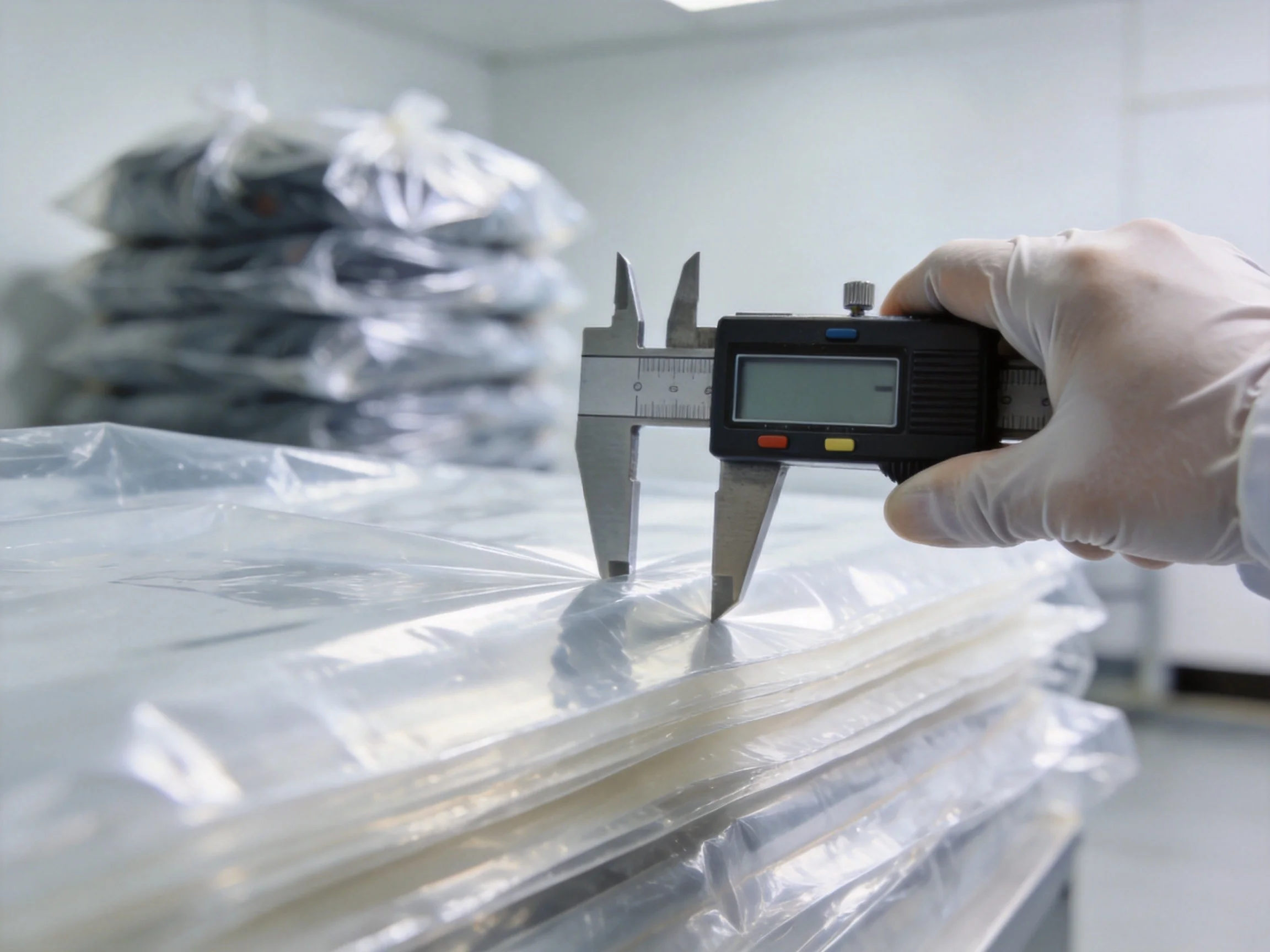
1. Leaks and Breakage (Top Complaint)
Symptoms: Bottom or side seals crack when full; bag “loses its bottom” when lifted.
Causes: ① Poor heat sealing (wrong temperature/pressure/time causing weak seals); ② Uneven film thickness (breaks start at thin spots); ③ Recycled content reducing strength; ④ Load capacity insufficient for the specification.
Testing: Seal strength test (tensile tester), drop test (fill with standard weight and drop from specified height), multi-point thickness measurement.
2. Odor
Symptoms: Pungent or sour smell on opening.
Causes: ① Recycled/low-quality raw materials; ② Poor-quality color masterbatch or filler; ③ Undried solvent residue from printing ink; ④ Excessive or low-quality additives (e.g., slip agents).
Testing: Sensory evaluation (Japanese customers are especially sensitive—almost a veto in food-factory applications); VOC testing if necessary.
3. Print Peeling / Blurring
Symptoms: Print rubs off, blurry patterns, misregistration.
Causes: ① Insufficient surface tension (poor corona treatment) reducing ink adhesion; ② Ink incompatible with the film material; ③ Insufficient drying temperature leaving solvent residue; ④ Worn print rollers or uneven pressure.
Testing: Tape pull test (apply tape to printed area and pull quickly), rub resistance test.
4. Uneven Thickness
Symptoms: Light transmission looks patchy; thickness varies significantly across the same bag.
Causes: Blown film process issues—uneven die gap, unstable air ring airflow, haul-off speed fluctuation, extrusion temperature variation.
Testing: Multi-point thickness measurement (top/middle/bottom); good lines control variation within ±5%.
5. Color Variation
Symptoms: Colors differ between lots in the same order, or vary within a lot.
Causes: ① Color masterbatch lot differences; ② Poor mixing; ③ Temperature changes during film blowing/printing affecting hue.
Testing: Colorimeter ΔE measurement against standard sample; keep signed standard samples.
6. Difficult to Open / Static Dust Attraction
Symptoms: Bags stick together and are hard to open; dust and dirt cling to the surface.
Causes: Static accumulation on the film; insufficient slip agent / antiblocking agent, or poor blooming.
Testing: Opening ease test (force required to open the bag), static test.
7. Dimensional Deviation
Symptoms: Width, length, or gusset doesn’t match spec, so bags don’t fit bins or packing machines.
Causes: Insufficient cutting precision in bag making, heat shrinkage, film tension fluctuation.
Testing: Measure each item with calipers; accept against specification tolerances.
8. The Quality Defense Line Factories Should Build
- Incoming material inspection: verify grade, melt index, and density per lot; prevent recycled content from entering
- First-article confirmation for film blowing: measure thickness and appearance before mass production
- In-process sampling for bag making: seal strength sampling and dimension checks per roll
- Final inspection (100% or sampling): appearance, dimensions, thickness, and printing, with a lot inspection report issued
- Sample retention and traceability: keep samples for 6–12 months per lot so causes can be identified by retesting when complaints arise
9. Food-Factory Quality Requirements and the Latest Testing Trends
Garbage bags and poly bags used in food factories must, since full enforcement of Japan’s Positive List system in June 2025, be proven to contain only listed raw materials. In addition to traditional “heavy metal and evaporation residue elution tests,” more food companies now require Positive List compliance certificates (PL certificates) for raw materials. Export suppliers need to obtain and retain resin manufacturer certificates lot by lot, ready to provide them to customers at any time.
Quality inspection is also going digital: automated multi-point thickness measurement, AI visual inspection (automatic detection of foreign matter, black specks, and pinholes), and cloud-based sharing of inspection reports are becoming the norm. More factories are moving from “paper inspection reports” to “data-visible inspections.” When evaluating Japanese OEM suppliers, whether they can provide lot-level inspection data electronically should be part of your selection criteria.
Summary
Most garbage bag quality issues are not “accidents”—they are the inevitable result of process and material control. Buyers only need to remember four keywords: seal, thickness, material, and printing. Set clear acceptance criteria at ordering and sample-inspect on delivery, and you can keep most quality risks at the door.
Looking for a Reliable Plastic Bag Manufacturer?
Shanghai Zhisheng Plastic has over 20 years of experience exporting high-quality plastic products to markets worldwide. With 5 production lines and rigorous quality control, we deliver consistent quality at competitive prices. Contact us today for a free quote or sample request.